
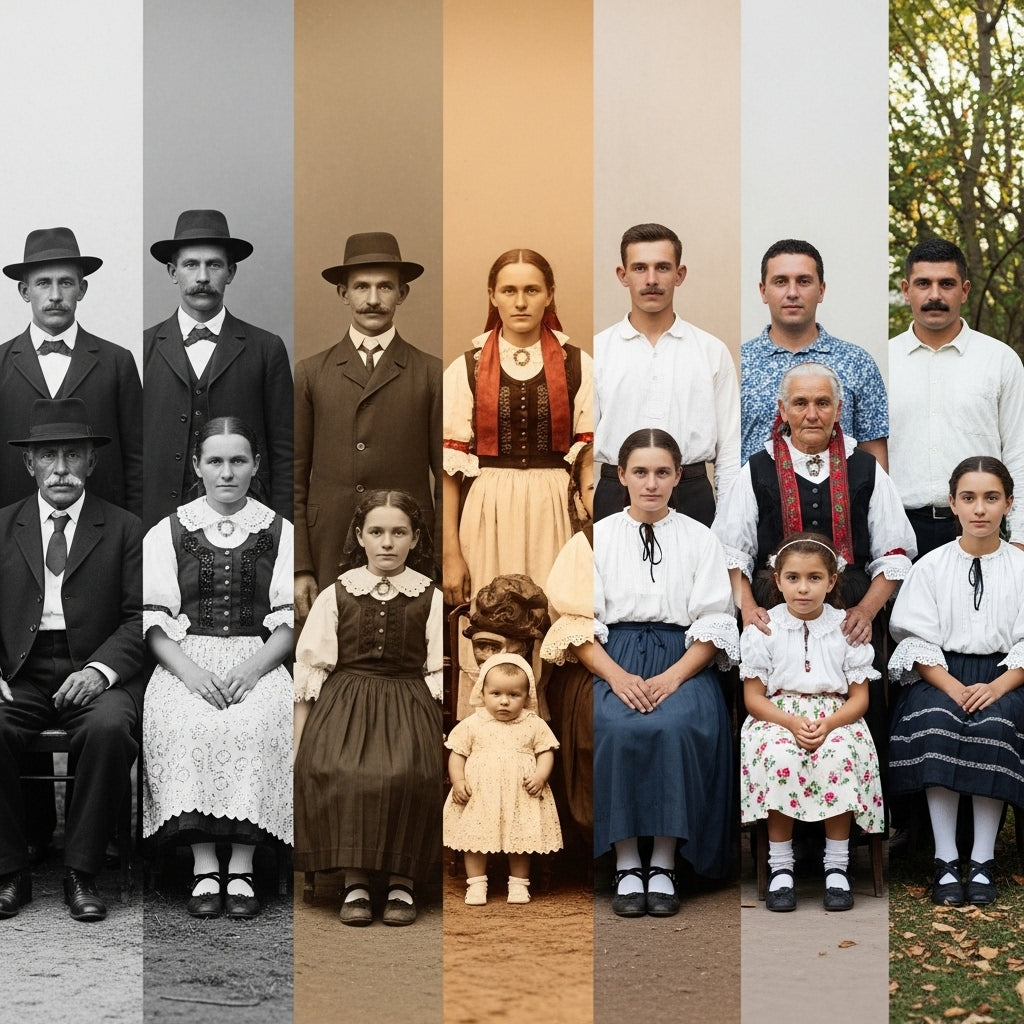
Common Hungarian Names & Their Meanings
Share
Delve into the world of Hungarian given names, family names, naming customs, and the symbolism behind popular Hungarian names.
1. Hungarian Name Order & Structure
In Hungary, names are conventionally written in the Eastern name order: the family name first, then the given name(s). In English contexts, order is often reversed for readability. For example, someone known as “János Kovács” in English appears domestically as “Kovács János.”
Officially, most people use one given name and one family name. Multiple given names exist but only one is normally used in daily life and documents.
2. Naming Traditions & Changes
Changing names after marriage. Hungarian women may keep their birth name, adopt the spouse’s surname, use a hyphenated/combined form, or take a traditional “-né” version tied to the husband’s surname. Men may also change or hyphenate, though it is less common.
Passing family names. Traditionally, children receive the father’s surname, though modern practice accommodates hyphenated and dual-surname solutions chosen by the parents.
3. Meanings & Etymology of Hungarian Names
Hungarian given names arise from diverse sources: native Magyar words, medieval coinages, and adaptations of Hebrew, Greek, Latin, Slavic, Germanic, and Turkic names. Some are poetic inventions (for example, Tünde from tündér, “fairy”), while others translate biblical or pan-European classics into Hungarian forms.
4. Examples: Classic & Modern Hungarian Names
Type indicates common usage; meanings and equivalents are conventional, not exhaustive. Accents matter in Hungarian orthography.
| Name | Type | Meaning / Notes | Common Equivalent |
|---|---|---|---|
| Gábor | Masculine | “God is my strength”; biblical | Gabriel |
| Balázs | Masculine | Hungarian form of Blaise | Blaise |
| Tünde | Feminine | From tündér, “fairy”; 19th-c. poetic coinage | — |
| Orsolya | Feminine | “Little bear” via Latin Ursula | Ursula |
| Farkas | Masculine | “Wolf”; also a surname | — |
| Erzsébet | Feminine | “God is my oath” | Elizabeth |
| András | Masculine | From Greek “manly, brave” | Andrew |
| Bence | Masculine | Modern favorite; related to Benedict | Benedict (dim.) |
| István | Masculine | “Crown, wreath”; royal name in Hungary | Stephen |
| Zoltán | Masculine | Likely from Turkic “sultan; authority” | — |
| Miklós | Masculine | From Greek “victory of the people” | Nicholas |
| László | Masculine | From Slavic Vladislav; royal name | Ladislaus / Leslie (hist.) |
| Gyula | Masculine | Old Hungarian title; historic given name | Julius (approx.) |
| Anna | Feminine | “Grace”; perennial favorite | Anna |
| Katalin | Feminine | From Greek “pure” | Catherine |
| Eszter | Feminine | Persian/Hebrew roots; biblical | Esther |
| Zsófia | Feminine | From Greek “wisdom” | Sophia |
| Ilona | Feminine | Often linked to Helen; folk variants | Helen / Helena |
| Réka | Feminine | Traditional; possibly Germanic/Turkic roots | — |
| János | Masculine | “God is gracious” | John |
| Pál | Masculine | Latin origin | Paul |
| Sándor | Masculine | From Greek “defender of men” | Alexander |
| Tamás | Masculine | Aramaic “twin” | Thomas |
| Ferenc | Masculine | From Latin Franciscus | Francis |
| Attila | Masculine | Historic name widely used in Hungary | — |
| Ágnes | Feminine | From Greek “pure, chaste” | Agnes |
| Judit | Feminine | Hebrew origin; biblical | Judith |
| Kinga | Feminine | Form of Cunegonde; Central European saint | — |
| Zsuzsanna | Feminine | Hebrew “lily” | Susanna / Susan |
| Noémi | Feminine | Hebrew “pleasantness” | Naomi |
| Emese | Feminine | Mythic ancestress in Hungarian legend | — |
5. Usage in International & Multicultural Contexts
Outside Hungary, Hungarian names are commonly rendered in Western order (given name followed by family name) to match local conventions. Data systems and official forms should clearly specify the expected order to avoid mismatches, especially when diacritics and hyphenated surnames are involved.